Fewer than 1,000 great green macaws remain worldwide — unlike scarlet macaws, which thrive across Costa Rica. Tortuguero is one of the only places on the planet where you can still see them in flocks. Here is why bird lovers travel here, and how a local conservation story turned a handful of birds into daily sightings.
The great green macaw (*Ara ambiguus*) is not the macaw you see on postcards from the Pacific coast. Scarlet and blue-and-gold macaws are flourishing in many parts of Costa Rica — loud, colourful and relatively easy to find. The great green macaw is different. It is one of the most endangered parrots on the planet, with credible estimates putting the global wild population at roughly 500 to 1,000 birds.
If you search online for "green macaw", "great green macaw Costa Rica" or "endangered macaw", this is the bird serious birders mean — and Tortuguero is one of the last places where seeing it is not a once-in-a-lifetime miracle, but a realistic goal on a morning walk or boat tour.
Why the great green macaw is so rare
Unlike scarlet macaws, which have adapted well to forest edges and reforestation projects in Guanacaste and the Central Pacific, the great green macaw depends on large, mature almendro trees (*Dipteryx panamensis*) for food and nesting cavities. When lowland rainforest is cleared for cattle or plantations, those giant trees disappear — and the macaws disappear with them.
Habitat loss and historical trapping for the pet trade pushed the species toward extinction across much of its former range from Honduras to Ecuador. Today, surviving populations are fragmented and small. That is why a flock of green macaws feels like finding treasure: you are looking at a significant fraction of the entire world population.
Tortuguero: a global stronghold
Tortuguero sits on Costa Rica's northern Caribbean coast — a maze of canals, rainforest and village gardens where almendro trees still line the waterways. For decades, local guides could count the macaws they saw on one hand. Twenty years ago, only a few pairs were reported around the village.
Conservation work, habitat protection in Tortuguero National Park and the surrounding buffer zone, and community pride in "their" macaws changed the story. Today it is common to see flocks — sometimes a dozen or more — flying between feeding trees at dawn or late afternoon, calling in that deep, rolling voice that carries across the canals.
Tortuguero is widely regarded as one of the best — and sometimes the best — places in the world to see the great green macaw in the wild. Birders who have chased this species in Nicaragua, Panama or the Osa Peninsula often tell us their clearest, closest views happened here.
How to tell a great green macaw from other macaws
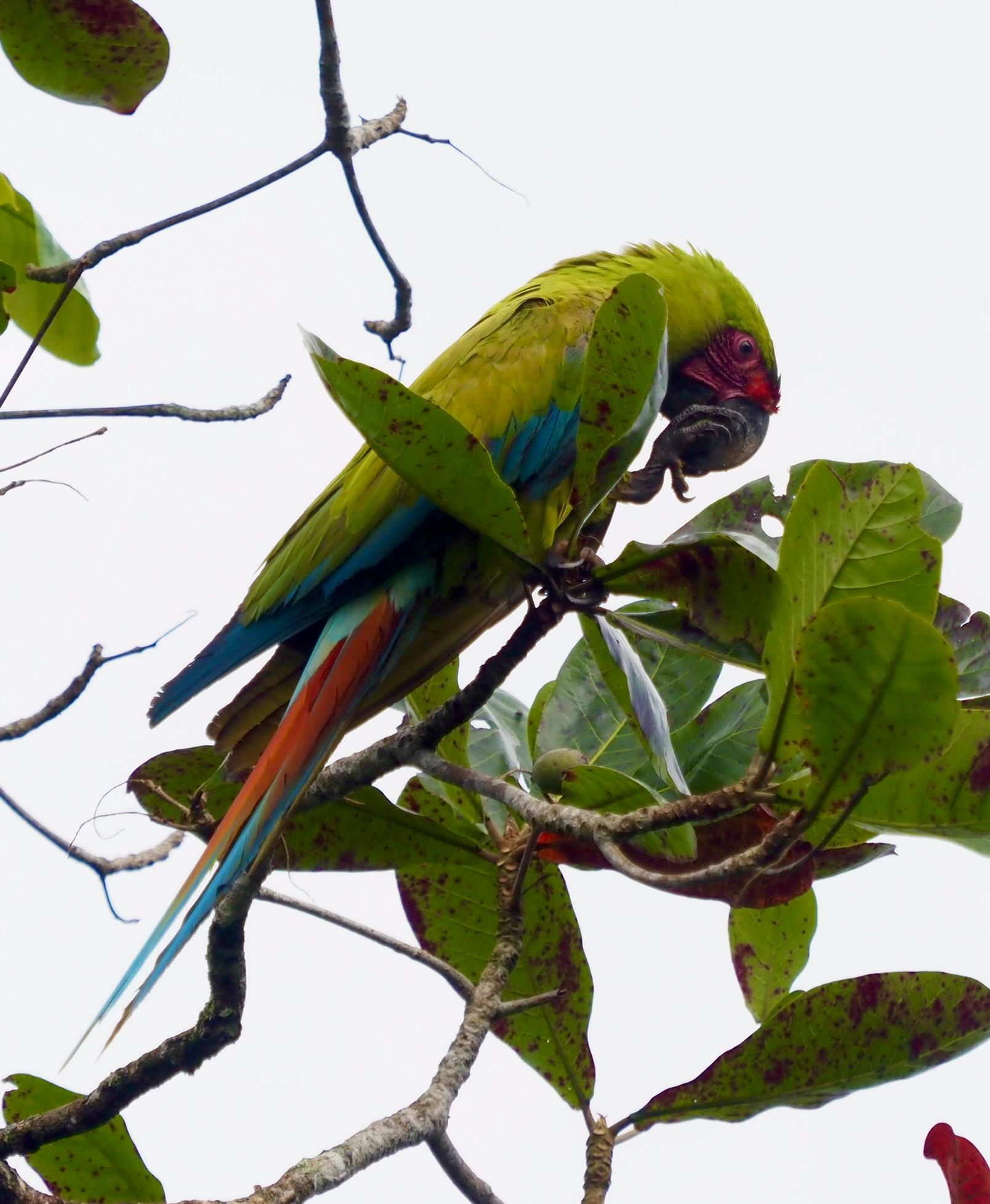
- •Size: one of the largest macaws — bigger than a scarlet macaw, with a long tail and broad wings.
- •Colour: mostly green, with a red forehead patch, blue on the lower back and rump, and a massive pale beak.
- •Voice: slower, deeper calls than scarlet macaws — listen for rolling "raaa-aaah" notes overhead.
- •Behaviour: often feeds quietly in the crown of almendro trees; scan treetops near the canal and the village edge.
If you have only seen scarlet macaws before, your first green macaw is unforgettable — not because it is louder or brighter, but because you understand how close the species came to vanishing.
Best time and place to look
Great green macaws are present year-round in Tortuguero, with the most reliable activity at first light and late afternoon when they move between roosting and feeding areas.
Good starting points include:
- •Canals and river edges where almendro trees overhang the water
- •The forest buffer around Tortuguero village
- •Guided routes our local birding guides use daily — they know which trees are active each week
You do not need to enter Tortuguero National Park for every macaw sighting; many birds feed close to the village. That said, combining a canal boat tour with a dedicated macaw walk gives you the best odds.
Our Green Macaw tour — built for bird lovers
At Hotel Serendipity we run a Green Macaw bird tour designed around this exact species. We provide binoculars, move at a birder's pace, and focus on field marks, behaviour and conservation context — not just a quick photo stop.
The tour lasts about 90 minutes, runs morning or evening, and does not require national park entrance for many of the best viewing spots. Our guides grew up on these canals; they remember when macaws were rare here, and they know how special it is that flocks are back.
Many guests tell us it was the emotional highlight of their Costa Rica trip — above turtles, above monkeys — because they came specifically hoping to see a bird the world is still trying to save.
A conservation story still being written
The recovery around Tortuguero is real, but fragile. One bad season of nest poaching, one stretch of forest cleared for the wrong crop, and the trend reverses. Tourism helps when it is done responsibly: hiring local guides, staying in community-owned businesses, and treating macaws with distance and respect.
When you book a stay and add the macaw tour, you are supporting the same village economy that chose to protect almendro trees instead of cutting them.
Planning your macaw trip
- •Bring: lightweight clothing, insect repellent, a camera with zoom (phone photos through our binoculars work well), and patience.
- •Leave behind: playback of parrot calls, drones near feeding trees, and the expectation that wildlife is on a schedule — macaws are wild birds, not performers.
- •Book direct with us for the best rate and to add the Green Macaw tour, canal boat trips and transport from San José or La Pavona in one WhatsApp conversation.
See them while they are still here
The great green macaw is not a symbol on a conservation poster — it is a living flock over Tortuguero, visible from a boat or a garden path if you know where to look. Twenty years ago that was almost unimaginable. Today it is one of the reasons birders put our village on their life list.
If you have been searching for where to see the green macaw, great green macaw Costa Rica, or endangered macaw tour, you have found the right place. Message us on WhatsApp at +506 7230-1518 or book your room and add the Green Macaw tour — we will have the binoculars ready.
Planning your Tortuguero trip?
Book direct and we'll arrange tours, meals and transport for you.